

I’ve seen dozens of recent takes about the rise of the GTM Engineer (‘GTME’) and the death of the SDR:
“The rise of the $200K SDR”, “GTM Engineers are the future”, and “I replaced my entire SDR team with Claude Code” are typical headlines.
These comparative takes miss the point.
Each role plays a crucial but different part in your go-to-market motion – and the top AI-native companies seem to agree. OpenAI, xAI, even Clay (who coined the term "GTM Engineer") are all hiring for both roles right now.
The debate shouldn’t be “GTM Engineer vs. SDR”. It should be “how do I get the most out of each role at my current stage?”
This article provides a framework for deciding when your outbound should be GTM Engineering-led (automated) versus SDR-led (human-in-the-loop) – and when that should change.
Let’s dive in.
First, Let’s Review the Differences Between GTM Engineers and SDRs
The GTM Engineer:
GTM Engineers have a unique skillset that sits at the intersection of technical chops and go to market strategy. They create lists, set up email infrastructure, build automations with code, and orchestrate automated signal-based outbound at scale (we’re talking 5,000+ accounts at a time). Today, most GTMEs report through RevOps.
SDRs:
SDRs are typically aspiring Account Executives (and should be your talent pipeline). Good SDRs excel at account based prospecting, cold calling, relationship building, and formulating hypotheses. They sometimes report to Marketing but should (in my humble opinion) report to Sales.
Comparison:
The main difference between the two skillsets as it relates to outbound can be captured by this chart:
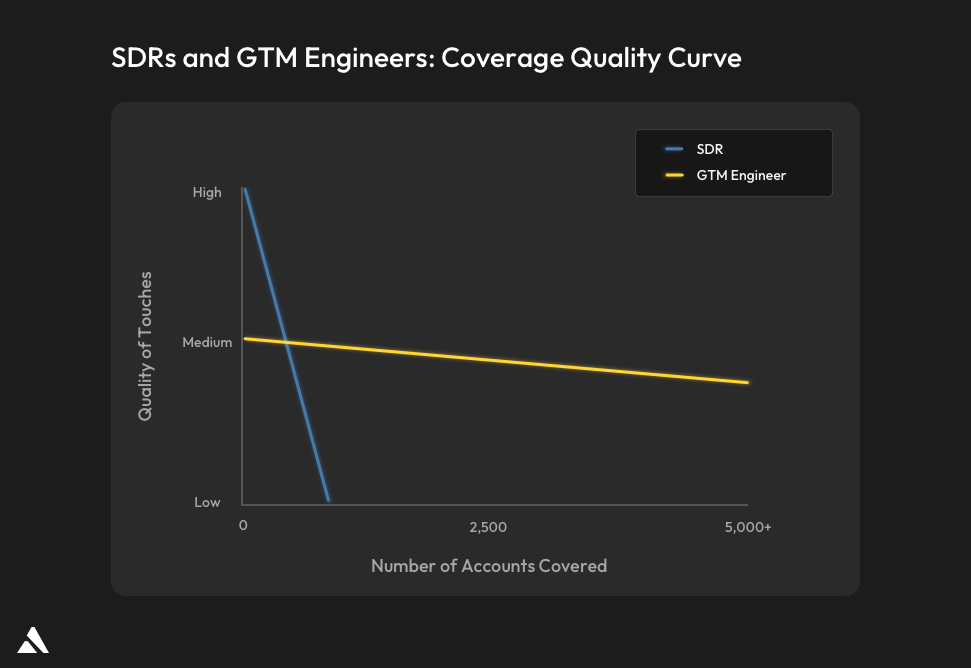
For those who didn’t take Economics 101: each line represents the relationship between “Quality of Touches” (i.e., how effective/thoughtful the attempt to break into the account is) and “Number of Accounts Covered” (i.e., how many accounts the rep is working).
The main takeaway: SDR (human-in-the-loop) quality is higher when focused but GTM Engineers (automated) can cover much more ground at a decent quality.
Going a step further, you can see there’s an “inflection” point when the GTM Engineer-led automated approach becomes more effective than human-in-the-loop:
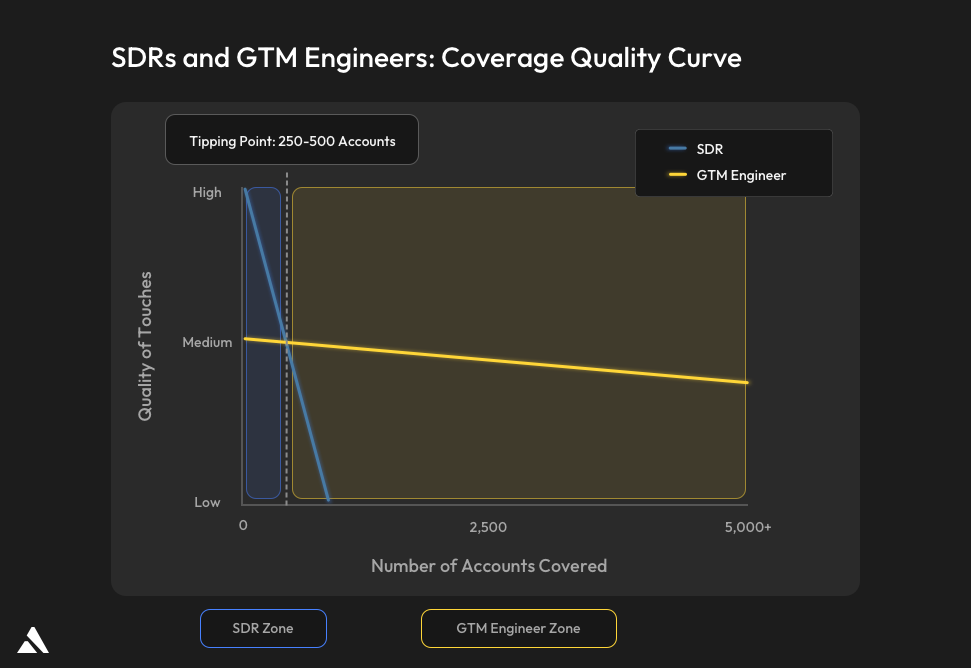
Of course, this depends on industry and company-specific factors (i.e., market awareness, available signals, competition, etc.), but the inflection point is usually in the range of 250-500 accounts per rep.
If you accept this, the outbound strategy question becomes a lot easier to answer:
It shifts from ‘philosophical’: “should I automate outbound or take a human-in-the-loop approach” to ‘economical’: “when does it make business sense for my reps to target more than 250-500 accounts each?”
The Decision Framework
This all depends on market penetration, deal economics and go to market budget:
Market Penetration: Extent of awareness, message and product-market fit.
Deal Economics: Average cycle complexity, cost and transaction size.
Budget: How much you can afford to invest in outbound and top-of-funnel.
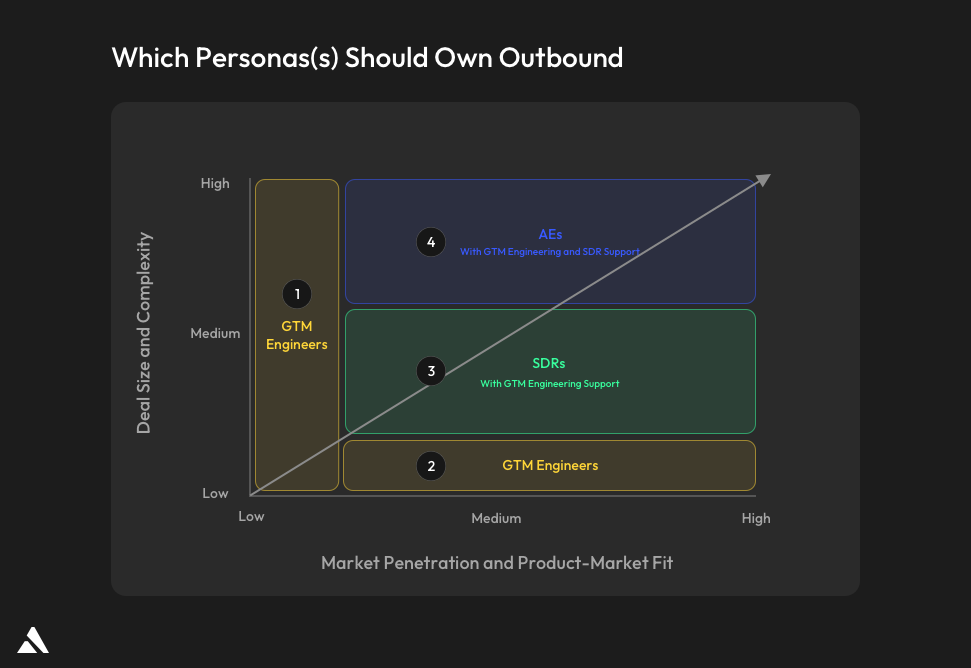
These three variables (typically) have some level of correlation and leads to companies falling into one of four go to market “zones”.
This chart shows the four go to market “zones” and which channel should own outbound for each zone:
When GTM Engineers Should Own Outbound:
GTMEs should automate outbound (to >250-500 accounts each) in two scenarios:
Early-stage startups with low market penetration (tons of targets, low budget).
Low-ticket solution ($10-$25K ACV range) that can’t justify a higher CAC.
GTMEs can target 5,000+ accounts through systematically tailored outbound, and in the two above scenarios, the economics of this approach works best:
Let’s say you have 5,000 target accounts, get 1% conversion, and close deals at $15K ACV. That’s $750K in pipeline. If a GTM Engineer costs $150K fully loaded, that’s a 5:1 pipeline-to-cost ratio. The same budget gets you two SDRs who can cover 1,000 accounts combined. Even if conversion triples to 3%, you’re still getting worse economics with only $450K in pipeline generated.
When GTM Engineers Should Support SDRs/AEs:
Reps should own outbound (and cover <250-500 accounts each) in two scenarios:
Proven product market fit and moving upmarket (SDRs own it).
Established enterprise vendor (AEs own, SDRs support).
Once you have proven product-market fit and are moving upmarket, human-in-the-loop becomes the better choice for outbound execution.
At this stage, you’re shifting from “cover the entire TAM” to “penetrate key accounts deeply.”
The multi-channel approach starts to matter – calling, social, email and in-person events are all required. SDRs and AEs can multi-thread into accounts, build relationships, and establish early champions in ways that automation can’t.
But here’s the key: GTM Engineers shouldn’t disappear. Their role just changes. Instead of owning outbound execution, they shift to building infrastructure and the systems that make each rep 2-3x more effective.
I’ll double down by saying I think it’s a mistake to hire SDRs without first investing in GTM Engineering (i.e., the automation infrastructure they need to succeed).
GTMEs should support AEs and SDRs by building automated:
Research and signal detection
Account and contact prioritization
AI-generated email drafts for reps to review
Execution of manual workflows
Analytics for continuous improvement
This is what GTM Engineers are being hired for at established organizations like Notion, Snowflake and Glean as I’m writing/posting this.
Wrapping Up
The companies building the most efficient go-to-market motions aren't choosing between GTM Engineers and SDRs. They're deploying each at the right stage: automation first to cover ground, then human touch to deepen relationships, then both working in tandem as the motion matures.
-Cam Wright
P.S. - if you enjoyed this article, feel free to leave a “like”, “comment” or “subscribe”. I read every comment and will make sure I get back to you.