

It’s February 2026 and other reps keep telling me that they’re booking less and less meetings through email.
On one hand this is no surprise. Buyers’ inboxes are being flooded with poorly AI-generated and automated emails. The bar to stand out keeps getting higher and higher, which forces most reps into a vicious feedback loop: after response rates drop, the instinct is to increase quantity to compensate, so quality falls, delivery is damaged and response rates drop even more.
However, with quality falling as everyone struggles to make the channel work, an opportunity has opened up for organizations that do three things extremely well:
Targeting: Account selection, specificity and timing
Content: Subject and email body text
Deliverability: Frequency of landing in the primary inbox
This article focuses on maximizing outbound email results through #2, Content.
Let’s dive in:
The Goal of Outbound Email
Before getting into the strategies, let’s make sure we’re on the same page.
At the fundamental level, a rep’s goal with an outbound email is to get a positive reply: a meeting, a referral, or at a minimum, helpful information.
Assuming the email is relevant and seen (targeting and deliverability working), buyers respond positively when two subconscious “green flags” flash in their brains:
Expertise: ‘This person knows their stuff and might help me’
Detachment: ‘Talking to them won’t be uncomfortable or pushy’
People actively avoid pushy reps, even when the product seems useful, because they don’t want to deal with aggressive follow-ups and pressure tactics.
With expertise and detachment as our ‘North Stars’, we have two levers to pull within our copy:
Information (the ‘What’): The specific facts and insights you share to prove you’re an expert.
Delivery (the ‘How’): The tone and formatting that signal you’re not a pushy solicitor.
“Information” is why they should care, but “Delivery” is why they actually reply. Let’s start with the ‘What’: Information.
Information
The best way to position yourself as an expert with information only is to:
Demonstrate you understand their world
Highlight a problem worth solving
Introduce a benefit associated with responding
And the simplest way to achieve these three objectives is to structure every cold email around four pillars:
Observation
Impact
Solution
Call-to-action
These are the four pieces of information you’ll try to “check off” with every cold email you send.
Observation
The observation is your “earned” entry into their inbox. It’s your reason for reaching out – something you saw, heard, or read about their business that proves it’s a targeted email.
The ideal observation: A company initiative or goal that implies they should care about the problem you solve.
Every company has dozens of problems but limited resources to solve them. When you lead with an observation that suggests it would be reasonable for your problem to be prioritized, you align your interests with theirs and earn the right to pivot into a ‘negative’ topic without seeming assumptive or insulting their current approach (no one likes their ‘baby being called ugly’).
Some common observation sources:
Conversations you’ve had with their coworkers
Company or department initiatives
Product announcements or changes
Job openings and descriptions
Industry news or shifts
As an example, let’s say I’m selling an AI SDR to a VP of Sales:
I find a LinkedIn post from their SDR Manager, Dave: “Hiring 4 SDRs to support our 100% revenue growth target in 2026.”
Instead of leading with “your SDRs aren’t good enough,” I reference the hiring plans and growth goal. Same problem (pipeline capacity), but now I’m aligned with their priority rather than criticizing their team.
If you can’t find a relevant initiative, default to a pain-related observation, but remember the bar is higher for making it land without defensiveness.
Impact
This is where you call out the pain or missed opportunity – the downside of their current approach.
Three rules for writing impact sentences:
1. Match their seniority level
Executives care about business outcomes (revenue, growth rate, valuation). Practitioners care about process pain (time wasted, manual work, frustration). Tailor accordingly.
2. Imply a cost of inaction (‘COI’)
The strongest impacts have a “negative consequence” if nothing changes factor built in. This is easy for cost savings (wasting money), but harder for things like process improvements. Either way, try to think of something that your reader can quantify as they read.
3. ‘Soften the blow’
Try not to sound accusatory or overly certain – this can trigger defensiveness. Use wording like “what usually slows teams down” or “the challenge I’ve seen” instead of direct “you’re doing this wrong”-type phrasing. Remove anything that suggests blame or fault.
Here’s an example of “Impact” building on our AI SDR example:
Long ramp cycles delay pipeline by 4-6 months (pushing revenue into future quarters), compounded by the fact that SDRs are bottlenecked by manual research, lots of sales leaders are finding it hard to achieve their plans.
Solution
This is where you introduce the alternative way of doing things or new opportunity that your solution enables.
Effective approaches:
Customer stories (”how Company X solved this”)
Metrics (”increased pipeline 30% in 60 days”)
Workflow explanations (”here’s what changes”)
Your solution statement should also be tailored to your prospects seniority:
At the executive level customer stories and statistics are typically most impactful (“[competitor] increased [metric] by 30%” by doing…”), whereas at the practitioner level a specific explanation of the new workflow (“here’s what changes”) can land well. Especially with technical buyers.
I recommend mixing approaches: a customer story + specific workflow details often lands best.
AI SDR example:
Automates targeting, research, hypothesis generation and email drafting, providing the pipeline output of 3-5 ramped SDRs immediately, without the hiring timeline, onboarding cost, or performance risk.
Call to Action (‘CTA’)
This is where you ask for the next step.
The CTA is where most reps lose the “Expertise + Detachment” balance. They build credibility through the email, then ruin it by sounding “needy” at the end.
The Data: Interest vs. Time
Gong’s data shows us that interest-based CTAs (asking if they care about the topic) outperform time-based CTAs (asking for a spot on their calendar).
Why? Asking for a meeting before they’ve agreed it’s valuable feels presumptuous – like you don’t respect their time or care whether this actually helps them.
The goal: Make your buyer feel in control of the entire interaction.
When you ask for interest instead of time, you give them an out. Ironically, by giving them an out, they are more likely to lean in.
Asking “would this be worth exploring?” or “interested in hearing how [Competitor] tackled this?” keeps them in charge and makes grabbing time with you feel low pressure.
Delivery
Delivery is the emotional perception of your message. You can have the best “Information” in the world, but if it’s wrapped in a formal, dense wall of text, your buyer will instantly categorize it as “Spam”.
To nail your delivery, focus on these three levers:
1. Scannability
Most emails are opened on cell phones. Keep it under 100 words so the entire message fits on the screen without scrolling.
2. Reduce cognitive load
Write at a 5th-8th grade reading level on the Flesch-Kincaid scale. Short sentences. Common words. One idea per sentence.
If you find yourself using complex vocabulary, it’s usually a sign you don’t understand what you’re selling well enough to explain it in simple terms. Busy prospects won’t work that hard to decode your message.
3. Be casual
Be conversational, not corporate. Use some lowercase words in the subject line. Use contractions (it’s, don’t). Write like a person who is busy, but helpful.
Bad: “I hope this message finds you well.”
Good: “Saw your post about the new GTM hire.”
Putting it All Together
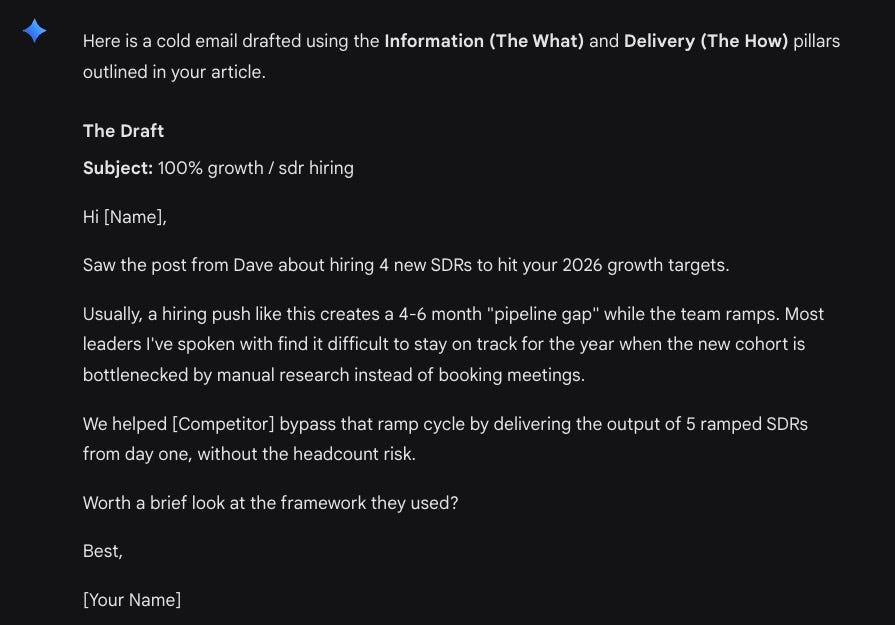
Here’s what a cold email to a VP of Sales selling an AI SDR looks like using this framework.
As an experiment, I asked Gemini to write this email with only a single prompt and didn’t change anything. The prompt I used was:
“Can you follow the strategies outlined in this article to write a cold email to a VP of sales if you were an AI selling an AI SDR? [Entire article up to “Putting it All Together” pasted here]”
Here’s the output:
The Verdict
Not bad for an AI one-shot. Is it perfect? Not quite. If I were sending myself I’d make a few tweaks:
I’d try to make the “observation” a bit more specific: can I find anything that the 2026 growth targets unlock? (i.e., funding round, IPO, etc.).
The “impact” is strong but the two sentences could be tied together better (i.e., adding something about ramping in the second sentence).
I’d mention AI or automation in the “solution” line somewhere so it’s clear I’m not selling a service.
Make the CTA more specific: “framework” doesn’t seem like a great word choice here.
Wrapping Up
By establishing expertise and detachment through the four pillars instead of leading with a pitch, you create emails that ‘earn’ replies rather than demand them.
Writing is the easy part. The hard part is research: finding relevant observations, understanding the true impact and knowing which solution angle will resonate. This is where AI should be focused: surfacing signals, connecting initiatives to pain points and identifying timing triggers.
-Cam Wright
P.S. - if you enjoyed this article, feel free to leave a “like”, “comment” or “subscribe”. I read every comment and will make sure I get back to you.